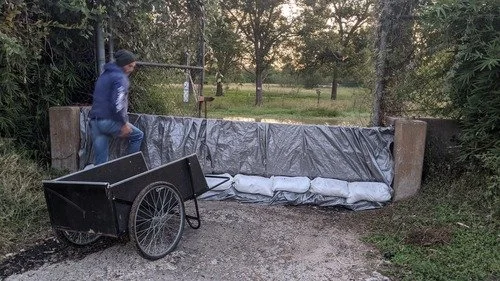
Flooding can disrupt animal care, facility access, transportation, utilities, and normal operations within a matter of hours. Floodwater Operations teams assist affected facilities through animal evacuation, transportation, water-based operations, facility support, and recovery activities.
This page provides a high-level planning reference for identifying the people, skills, and equipment that may be needed for a floodwater response.
Floodwater Operations at a Glance
Capability type: Incident response
Possible team size: 2 or more responders
Primary focus: Animal evacuation, transportation, facility support, water-based operations, and recovery
A team may be composed of responders who share the same capability or of responders with complementary skills. The appropriate makeup of the team will depend on water conditions, facility needs, animal requirements, available equipment, and the scope of the incident.
-
These capabilities are likely to be central to a Floodwater Operations team.
Animal Husbandry
Supports animal care, feeding, observation, handling, and welfare during emergency operations or temporary relocation.Animal Transport
Supports the safe preparation, loading, movement, unloading, and relocation of animals.Boat Operator
Operates watercraft to transport personnel, animals, equipment, and supplies or to assist with reconnaissance.Slack Water Operations
Supports transportation, animal movement, reconnaissance, rescue, and recovery in calm or slow-moving water.Swift Water Operations
Provides specialized rescue, evacuation, transportation, and recovery capabilities in moving or flood waters where advanced training is required.Safety note: Water-based operations should only be assigned to responders with the experience, training, and certifications appropriate for the conditions.
-
Depending on the facility and incident conditions, the following capabilities may also be needed.
Veterinarian
Provides animal health assessments, treatment, triage support, biosecurity guidance, and veterinary consultation.Veterinary Technician
Supports patient monitoring, treatment assistance, permitted medication administration, and medical recordkeeping.Heavy Machinery Operator
Operates specialized equipment to support debris removal, material movement, site access, and recovery.Administration, Coordination & Logistics
Supports documentation, scheduling, resource coordination, data management, and logistical planning.Safety and Security
Provides risk assessment, responder safety oversight, site security, access control, and incident monitoring. -
Floodwater teams may require:
Boats and motors
Personal flotation devices
Throw bags
Water-rescue equipment
Animal transport crates
Trailers
Communications equipment
Animal-handling equipment
Appropriate personal protective equipment
The equipment required for a particular deployment will depend on water conditions, the species involved, transportation needs, facility access, and assigned objectives.
-
Begin with the capabilities that are central to the mission, then add supporting personnel based on the conditions at the impacted facility.
Questions to consider include:
Are animals likely to require evacuation or temporary relocation?
Are operations taking place in calm water, moving water, or both?
Will boats or specialized rescue equipment be required?
Are veterinary assessment or medical support likely to be needed?
Is heavy equipment required to restore access?
Who will oversee safety, communications, and logistics?
Can the team operate independently with its available personnel and equipment?
One responder may fulfill more than one capability, but assignments should account for training, safety, workload, and mission complexity.
-
Animal Husbandry, Aquatic
Animal Husbandry, Terrestrial
Animal Transport
Boat Operator
Slack Water Operations
Swift Water Operations
Veterinarian
Veterinary Technician
Heavy Machinery Operator
Administration, Coordination & Logistics
Safety and Security
-
Response Team Readiness
Choosing Team Members
Deployment Strategy
Individual Responder Readiness
Response Team Capabilities
Crew Lead
Safety Lead
Communications Lead
Needs Assessor
Important Note
This page is intended as a planning reference. It does not replace required training, professional judgment, incident-specific safety planning, or the direction of qualified response leadership.